
Alexander Karlsson
Why are we sharing everything just to prove one thing?
Zero-knowledge proofs are making privacy practical. Instead of sharing who you are, you can now prove what's true about you without revealing anything else.
Lately, I've been thinking a lot about privacy.
Not the big-picture stuff. The everyday friction. Like when you're asked to upload an ID, take a selfie, or "just verify your age real quick" and wonder why this needs to reveal so much information.
The Only Tool We've Had
If you've ever bought liquor in Scandinavia, you've probably had this moment. You're standing there, and all the system actually needs to know is: are you over 18?
Instead, you're asked to show an ID that reveals far more than that. Not because it's ideal, but because for a long time, it's been the only tool we've had.
For years, attempts to fix this focused on who owns identity. Concepts like Decentralized Identifiers (DIDs) moved identity ownership closer to the user, but they didn't fully solve the core issue: you still had to expose large parts of your identity every time you wanted to prove something. Ownership improved. Exposure didn't.
What changed recently is that zero-knowledge proofs stopped being purely academic.
Proving Things Without Telling Them
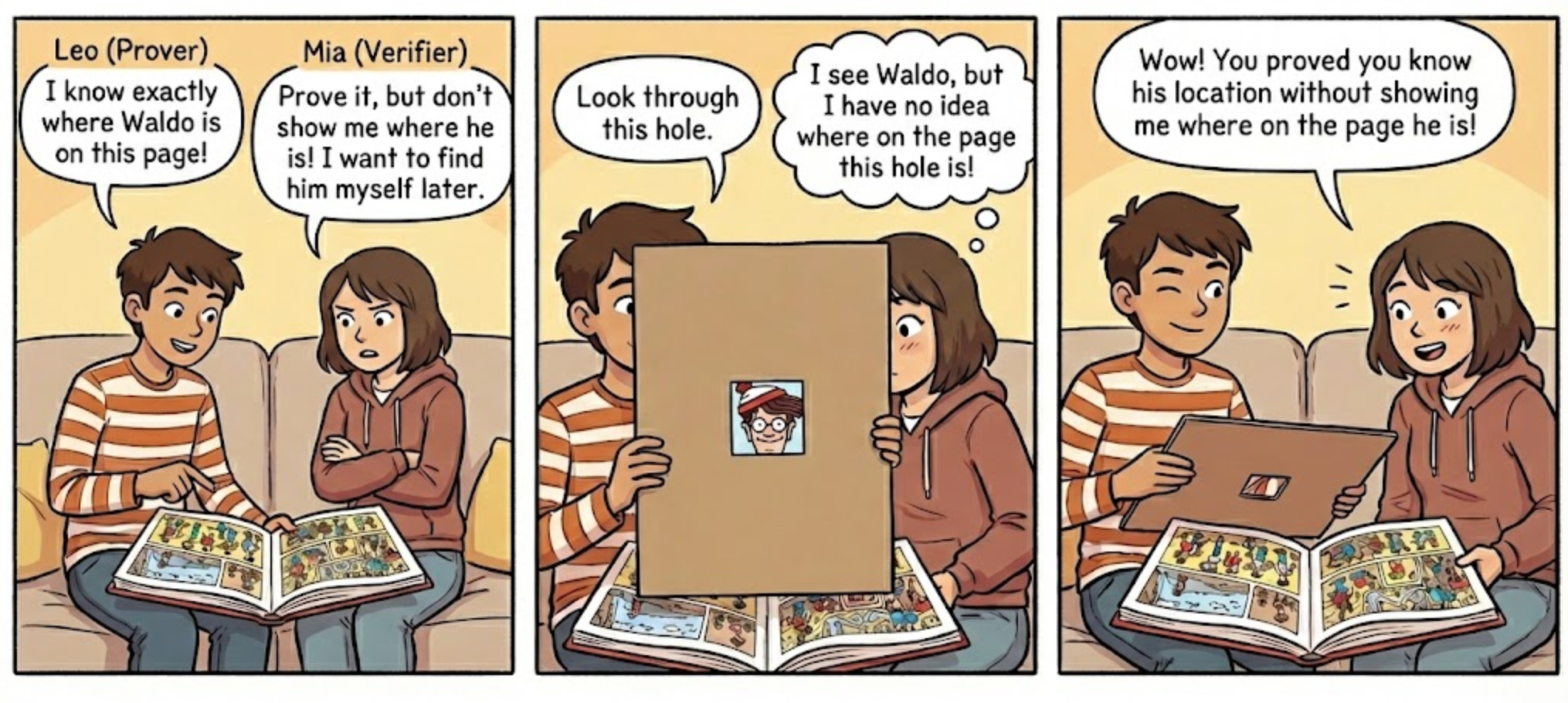
Zero-knowledge proofs let you prove something is true without revealing the data behind it.
Instead of saying who you are, you prove what's true about you. Instead of sharing identifiers, you share proofs.
Tooling like Noir is what made this finally click for me. It's an open-source zero-knowledge programming language that makes it possible to build these kinds of systems without being a cryptography researcher. You describe the condition, generate a proof, and let others verify it without learning anything else.
Projects like ZK Passport build on this idea by allowing proofs derived from passports or national IDs on your smart device without revealing the document itself or leaking device information. You don't hand over your identity, you prove that you meet the requirements.
When Proof Becomes More Valuable Than Data
Once you start thinking this way, the implications go far beyond identity.
Health can be an example. You could prove that a value from Apple Health is within a healthy range, or that you meet a requirement, without exposing raw health data or medical history.
But the same idea applies elsewhere:
- Proof of residency without sharing an address.
- Proof of uniqueness without identity related data.
- Proof of income range without revealing exact numbers.
The pattern is always the same. Prove the fact, keep everything else private.
Okay, That's Cool, But Why Should I Care?
Because right now, you're trusting a lot of companies with a lot of your data.
Every time you verify your age, prove your address, or confirm your income, you're handing over documents to a company's database. And once it's there, you're hoping they store it safely. Hoping they don't get breached. Hoping they don't sell it. Hoping their third-party vendors are just as careful.
In the name of compliance, control, and regulation, we're slowly giving away more and more.
The promise has always been: "We need this information to verify you're legitimate." And for a long time, that was true. There was no other way.
Zero-knowledge proofs break that assumption. You don't need to trust the company to protect your data if you never give them your data in the first place. You just give them a proof.
The company gets what they need, a verification and you keep what you need, your privacy.
Why Web3 Needs This
This is where blockchain starts to make more sense.
I've been building on-chain for a while now, and one tension I keep running into is this: blockchains are transparent by design. Everything you do leaves a trace. Every transaction, every interaction, every wallet balance is public by default.
We're pseudonymous by default, sure. But the moment someone knows your wallet address belongs to you, they can trace your entire financial history. Every transaction. Every balance. Every interaction.
Suddenly, paying a friend back for lunch means putting them on a public money trail they never asked to be on. If someone identifies either of your addresses, they can see the full picture: how much you spent, who you interact with, what you hold.
That transparency is powerful for some things. It's what makes smart contracts trustworthy and auditable. But it's also why so much Web3 adoption feels stuck.
Most people don't want their financial history, voting choices, or health data sitting on a public ledger forever. And they definitely don't want to accidentally expose their friends' financial activity just by transacting with them.
Zero-knowledge proofs don't replace blockchain's transparency. They complement it.
You can prove you're eligible to participate in something on-chain without revealing why you're eligible. You can vote without exposing how you voted. You can prove you have sufficient funds without broadcasting your entire wallet balance.
Take Aztec as an example. They ran their entire token presale on-chain while using ZK Passport to verify that investors weren't on OFAC sanctions lists or from restricted countries. Every participant could prove compliance without exposing their identity or passport details to the company or blockchain.
And if we circle back to my own project FML, we could use Zero-knowledge proofs to let managers prove they own their team without me getting their personal identity or storing valuable information about the user.
But here's the thing: most Web3 projects aren't using this yet.
We're still in the phase this technology has been too hard to implement but the tooling is getting better, and the developer experience hasn't been great.
Which means there's a gap. And gaps like this are exactly where the next wave of interesting projects comes to life. A lot of interesting projects are listed here awesome-noir
And just like most meaningful infrastructure shifts, this feels early, slightly uncomfortable, and harder than it should be.
Which is exactly why I'm excited about it.